

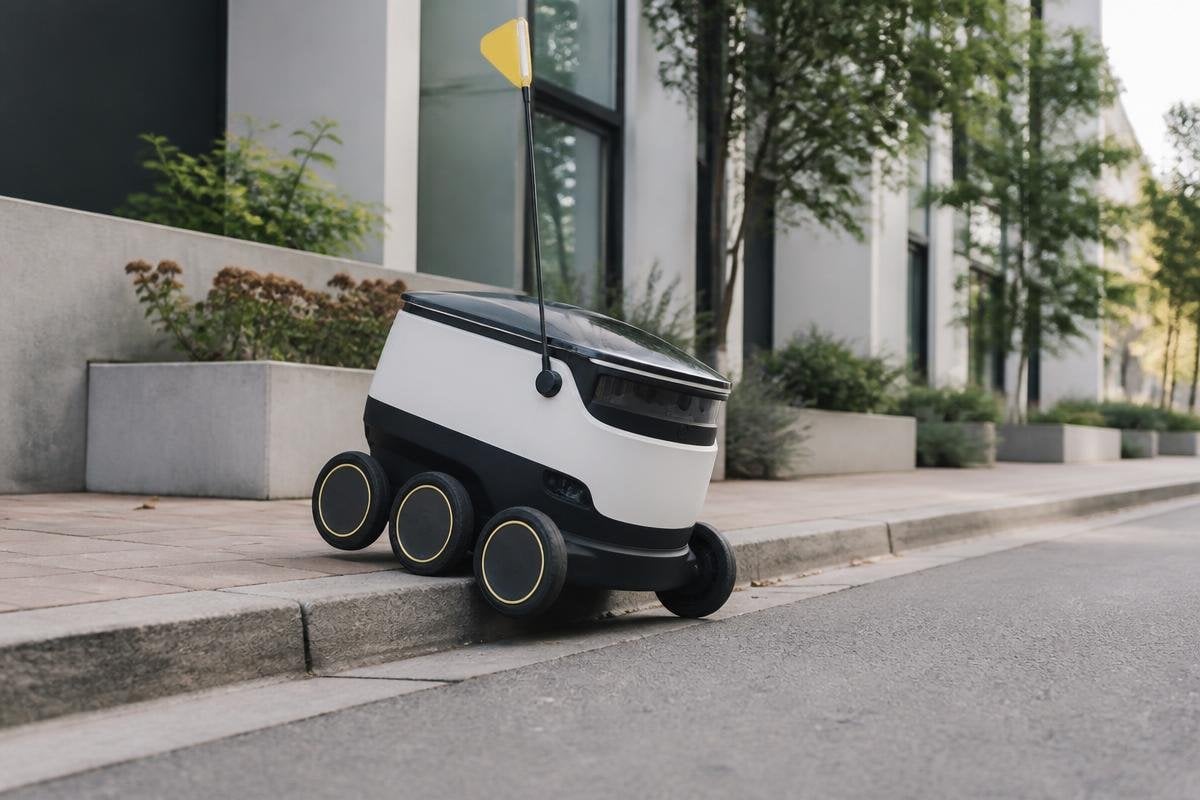
A delivery robot can carry a parcel across a sidewalk, but the last few metres still decide whether the job works. The next stage of last-mile automation will depend on how well these machines handle curbs, doors, people, weather, and handoff points.
Quick read
- Sidewalk travel is only one part of the delivery
- Remote help will remain part of many robot services
- Safe handoff matters as much as movement
The route is harder than the map
A map can show a route from a shop to a home. It can’t fully describe a blocked sidewalk, a parked vehicle across a ramp, or a customer who isn’t at the door.
The robot has to sense the space around it and choose a safe action as conditions change.
That work needs cameras, depth sensors, location data, and software that can combine those inputs. The useful question isn’t whether a robot can follow a marked path. It’s whether the robot can stop, wait, reroute, or ask for help without holding up the delivery.
A low curb can be a bigger problem than a long street. A narrow gate can matter more than the distance between the warehouse and the customer. These details will shape where companies place delivery robots first.
People remain part of the system
A delivery robot shares space with pedestrians, bicycles, pets, and vehicles. It needs to move at a pace that gives people time to react, while also making its purpose clear through lights, sounds, or a screen.
When the robot reaches a building, the route changes again. It may stop at a gate, a lobby, or a set of steps. A remote operator can help with unusual cases, but that adds staff time and a second operating cost to each delivery.
That extra staff time makes outside trial records useful. Robot24.com delivery robot reporting can place a company’s claims beside named machines, test dates, and control methods, so you can see how much work the robot handles before a person steps in.
The remote link also needs a clear limit. If a person must guide the robot through every difficult section, the system has shifted from autonomous delivery to remote driving with a robot in the middle.
The handoff decides the service
Movement gets the parcel near its destination. Handoff gets it to the right person.
A workable service needs a way to confirm the customer, protect the parcel, and handle a missed delivery. A locked compartment can help, but it adds weight, power use, and another part that can fail. A phone code can confirm access, though it depends on the customer having a charged phone and a usable signal.
The design also has to fit the delivery itself. Groceries, medicine, prepared food, and small parcels bring different time limits and storage needs. A robot that works for a sealed package may be a poor fit for food that needs temperature control.
Privacy matters too. Cameras may help the robot read its route, but the service needs clear rules for stored images, access, and deletion. Customers will judge the machine by what happens at their door, not by the quality of its navigation software.
What will decide the next deployments
The first useful services will probably run on routes with repeatable conditions. A campus, housing site, business park, or planned neighborhood gives the operator fewer unknowns than a dense city route with mixed traffic and old sidewalks.
That doesn’t make the technology less useful. It gives companies a place to measure missed handoffs, remote interventions, blocked paths, charging time, and damage claims before they widen the service area.
I’d put curb access and handoff design ahead of top speed when judging a delivery robot. A faster machine still loses money if it spends each afternoon waiting at doors or asking a person to take over.
A practical buyer’s checklist
Before you support a delivery robot pilot, check these points:
- Route access: Walk the full path and record curbs, ramps, gates, steps, and narrow sections.
- Human help: Set a limit for remote interventions and count the staff time they use.
- Parcel fit: Match compartment size, weight limits, and temperature needs to the goods.
- Customer handoff: Test missed deliveries, identity checks, locked storage, and returns.
- Safety records: Define how the service logs stops, collisions, near misses, and blocked routes.
- Service cost: Count charging, cleaning, repairs, supervision, and failed delivery attempts.
These checks turn a robot trial into a service test. They also show where the machine needs work before a wider rollout.
The next useful proof will come from repeat routes with public figures for delivery time, remote help, missed handoffs, and repair cost. Until companies publish those numbers, last-mile delivery robots remain promising machines waiting for a complete operating model.